
ChatGPT Ads are coming to the UAE. Here is the window they leave open for small business
ChatGPT Ads are not buyable in the UAE yet, and 73% of the brands paying to advertise inside ChatGPT are never cited as a source. Here is what UAE SMEs should build while the window is open.
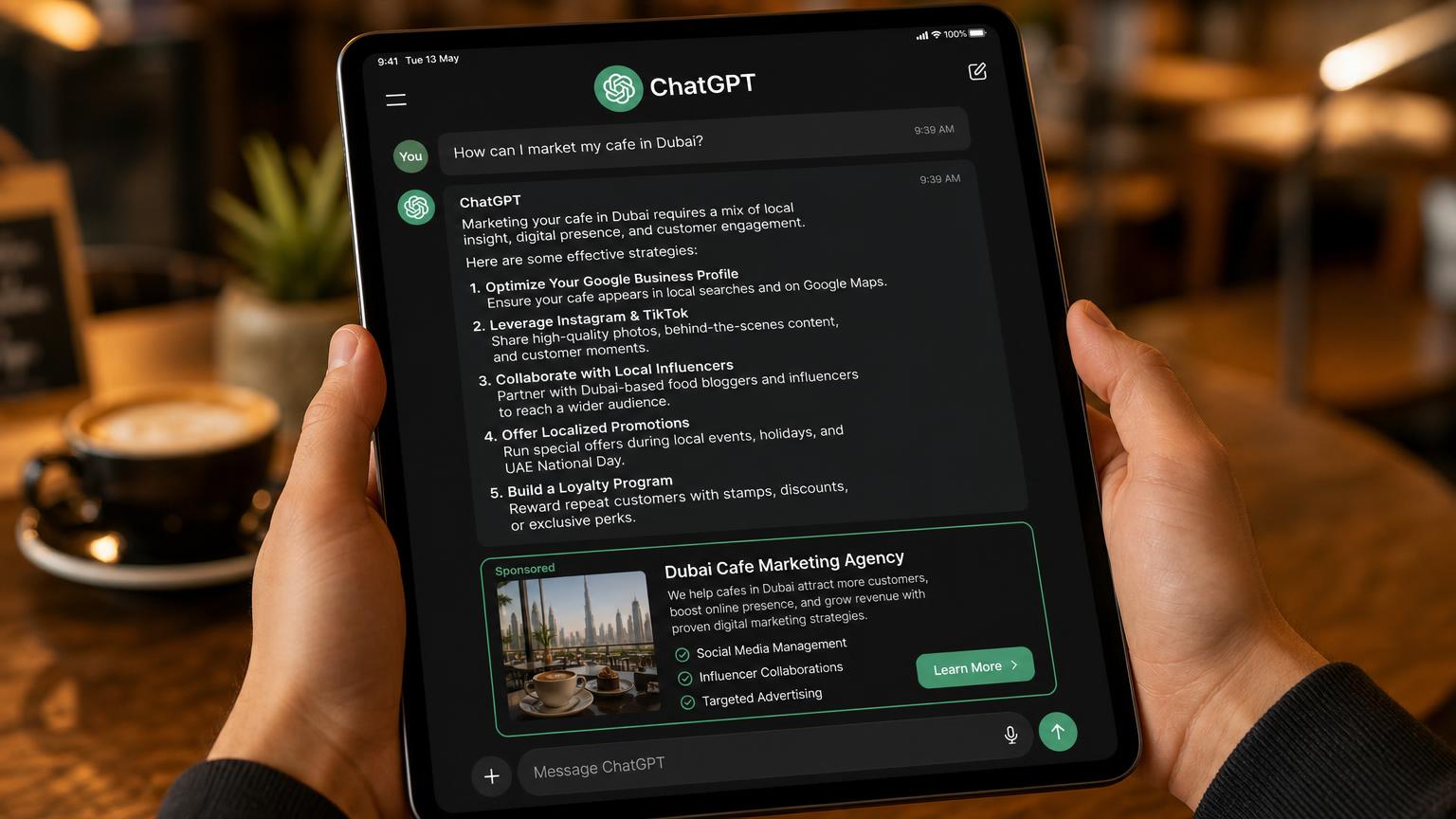
Last week the AI answer box quietly became an advertising channel for most of Europe. ChatGPT Ads are not yet buyable in the UAE, and if you run a clinic, a cafe, a gym, a garage or a brokerage here, that gap is worth understanding rather than worrying about.
Because buried in the data on how these ads actually behave is a finding that changes what you should be doing this month. The businesses buying the ads are, overwhelmingly, not the businesses being recommended.
Those are two different systems. One costs money. The other costs attention. Only one of them is available to you right now, and it is the one that lasts.
What actually happened, and when
On 18 August, OpenAI announced it was taking ChatGPT Ads into 31 European markets, with serving beginning the following week. OpenAI's own announcement called it "our largest expansion to date" and named Germany, France, Spain, Italy, Sweden, Norway, Denmark, the Netherlands and Austria among the countries included.
The pace is the story. OpenAI began testing ads in the United States in February. In the six months since, it expanded to eight additional markets, then added 31 more in a single move. "Tens of thousands of marketers have now advertised on ChatGPT," the company says.
It has also built out the machinery properly. OpenAI describes moving beyond CPM and CPC bidding to conversion optimisation, adding geo-targeting and custom audiences, and measuring beyond clicks through its own pixel, a conversions API and third-party integrations. That is not an experiment. That is an ad platform.
One detail matters for how you think about reach: ads appear only for people on ChatGPT's Free and Go plans. Plus, Pro and Enterprise subscribers stay ad-free.
The number that matters more than the expansion
Here is where it gets genuinely interesting for a small business owner.
An analysis by the AI visibility platform LLM Pulse examined 137,038 real ChatGPT answers collected between 25 July and 4 August 2026, including 36,153 served to users in the United States. It found that 71.9% of US answers carried at least one ad, 26,003 of 36,153. As the study puts it, an ad "is now the normal state of a ChatGPT answer in the US, not the exception."

Now the part almost nobody is talking about. Only 2.8% of those ads pointed at a domain that the same answer also used as a source. Across the whole sample, 73% of advertisers never appeared as a source in any answer at all.
Nearly three quarters of the brands paying to appear inside ChatGPT are brands ChatGPT does not cite when it actually answers the question.
Being advertised and being recommended are separate outcomes, produced by separate systems. Money buys the first. Only being genuinely useful and verifiable buys the second. It is worth noting this is a vendor study rather than a peer-reviewed one, and it covers a ten-day window during an active rollout, but the direction it points in matches everything we already know about how these systems choose their sources.
Why the UAE's absence is an advantage right now
The UAE is not on OpenAI's serving list. That will change; the trajectory from one market to forty in six months makes that obvious. But while it lasts, you have something valuable.
Your competitors here cannot outspend you into the answer. Nobody in your category can buy their way to the top of a ChatGPT response about the best physiotherapist in Jumeirah or the best brunch in Al Quoz. For now, the only route in is the earned one.
So the sensible move is not to wait for the ad platform to arrive. It is to spend the next few months building the thing the ad platform will not be able to replace, so that when paid placement does land, you are already the answer sitting above it.
That is a rare kind of head start, and it has a deadline.
Google is quietly doing the same thing to the booking step
While OpenAI was expanding its ad footprint, Google made a change to the moment just after the decision.
On 25 August, Google confirmed it was expanding direct booking in Local Services Ads from around 20 Reserve with Google booking partners to more than 500. Advertisers whose Google Business Profile already has an active partner booking link get the capability switched on automatically, with no manual linking required.
There is a commercial detail worth noting. Google says bookings made through these ads flow into Local Services Ads lead reporting as paid leads. Google Ads Liaison Ginny Marvin also confirmed that booking preferences will carry over as Google migrates Local Services Ads accounts into Google Ads over the coming months.
The pattern across both companies is the same. The distance between "I have a question" and "I have booked" is being compressed into a single surface that you do not own. Clinics, gyms, garages and salons are exactly the categories this affects.
Your practical response is unglamorous but effective: make sure your booking system is one of the connected ones, and make sure the appointment types, prices and availability it exposes are accurate. An ad that leads to a broken booking flow is worse than no ad.
The UAE consumer is unusually ready for this
This shift will land harder here than in most markets, because UAE consumers have already adopted the behaviour.
Visa's annual Stay Secure study, conducted by Wakefield Research and reported by the Emirates News Agency in June, found that 85% of people in the UAE have used AI tools to help with shopping. Within that, 60% used them to check reviews or product ratings, 59% to compare prices and 55% to find gift ideas. Ninety-three per cent said new technologies are making online shopping faster and easier.
But trust has a clear ceiling. Only 32% would trust an AI agent to complete a checkout. People are happy to let AI do the research and reluctant to let it hold the wallet.
Checkout.com's MENA research points the same way, finding 77% of UAE consumers familiar with agentic AI, half of MENA consumers comfortable with AI shopping on their behalf, and just 2% saying nothing would make them more confident.
The message for an SME is straightforward. AI is now sitting in the research phase of almost every purchase decision in this country. It is not yet closing the sale. Your job is to be the name it hands over at the moment the human takes back control.
What this means sector by sector
Healthcare clinics
The booking change is the one to act on. If your clinic uses a scheduling platform, check whether it is a Reserve with Google partner now that the list has grown past 500, and make sure your Google Business Profile booking link is live and accurate.
Then write the pages an AI needs in order to name you: named consultants with real credentials, the conditions you actually treat, insurance networks you accept, and honest recovery timelines. Given that only 32% of UAE consumers would let an AI complete a transaction, your goal is not automated conversion, it is being the clinic a patient rings after the AI has narrowed it to three.
Restaurants and cafes
Your channel mix has already shifted more than most owners realise. Syrve MENA data reported by Khaleej Times shows delivery reached 30.5% of all restaurant orders in the first half of 2026, up from 25.4% a year earlier, while dine-in orders fell 10.5%.
The economics of that are brutal and clarifying. The average delivery ticket was Dh76.97 against Dh115.81 for dine-in. Every dine-in cover you win back is worth roughly one and a half delivery orders.
So publish what an aggregator listing cannot: your full menu as real text, your dietary options, your seating, your terrace hours, whether you take walk-ins on a Friday night. An AI asked to recommend somewhere for a quiet dinner for six cannot read your menu if it lives inside a photograph.
Gyms and fitness
Speed is your lever. Checkout.com found 68% of UAE shoppers want to move from inspiration to purchase as quickly as possible, and 21% named saving time as their main motivation for using an AI agent.
Someone who has just been told your studio is the best option for early-morning strength training will act within minutes or not at all. That means your prices, class timetable and trial offer need to be visible, current and one tap from wherever they land. A form that promises a callback is a conversion leak.
Automotive workshops and showrooms
Two Visa figures should shape your website: 60% of UAE consumers use AI to check reviews and ratings, and 59% use it to compare prices. Both of those are questions your category has traditionally answered only over the phone.
Publish indicative service pricing, state clearly whether parts are genuine or equivalent, say how long common jobs take, and be explicit about warranty implications. Then keep your reviews recent and reply to every one. You are supplying the two inputs the AI has been asked to weigh.
Real estate brokerages
Sixty per cent of UAE consumers typically discover new brands or retailers while shopping online, according to the same Visa study, and in a market with this much transaction volume, discovery is where the margin sits.
Resist the temptation to publish more. Publish better: verified listings, genuine building-level knowledge, service charges, handover histories, honest views on which communities suit which buyers. Thin, duplicated listing pages are precisely what both Google's recent enforcement and the AI answer layer are built to ignore.
Three things to do this month
- Audit what an AI can actually read on your site. Open your most important page and ask whether your prices, services, hours and location exist as plain text rather than inside images or PDFs. If they do not, nothing else on this list matters.
- Connect and verify your booking. With the Reserve with Google partner list past 500, the odds your platform is now supported have improved considerably.
- Use the free help sitting in front of you. du Business announced on 18 August a programme offering free, practical Agentic AI training to 10,000 UAE SMEs, delivered in phases. And Dubai's SME in a Box drew more than 500 expressions of interest in its first month, with Dubai SME's chief executive Ahmad Al Room Almheiri telling Khaleej Times it has generated "an estimated Dh20,000 in savings for per SME and saved them 500 hours of research and onboarding."
Free training and Dh20,000 of savings is a better use of the next quarter than waiting for an ad auction you cannot yet enter.
Frequently asked questions
Can UAE businesses buy ChatGPT Ads right now?
Not through OpenAI's serving markets. As of the 18 August announcement, ChatGPT Ads serve in the United States, eight further markets and 31 European countries. The UAE is not among them, though the pace of expansion suggests that will change.
Do ChatGPT ads help you get recommended in the answers?
The evidence says no. In LLM Pulse's sample, only 2.8% of ads pointed to a domain the same answer cited as a source, and 73% of advertisers never appeared as a source anywhere. Paid placement and organic citation appear to be separate systems.
What percentage of ChatGPT answers contain ads?
In the United States, 71.9% of answers in LLM Pulse's 36,153-answer US sample carried at least one ad during the 25 July to 4 August 2026 window. Rates were 73.6% in Australia, 65.4% in New Zealand and 60.4% in Canada, but just 0.08% in the United Kingdom at the time of collection.
Are UAE consumers actually using AI to shop?
Yes. Visa's Stay Secure study found 85% of UAE consumers have used AI tools to assist with shopping, though only 32% would trust an AI agent to complete a checkout.
What is the single most useful thing to do first?
Make your prices, services, opening hours and location available as readable text on your own website. Every system discussed here, Google's ranking systems, its AI features and third-party assistants, depends on being able to read that.
Where this leaves you
The AI answer layer is becoming a paid channel. That was always going to happen. What is genuinely useful is knowing, this early, that paying for it and being chosen by it are two different things.
For the next few months, UAE small businesses can compete for the second one on merit alone. That is not a loophole. It is simply what happens when the marketing world moves faster than the billing systems behind it.
If you would like help working out what an AI assistant currently says about your business, and what it would take to change that answer, get in touch. It usually takes less work than owners expect, and the window is open now.
Sources
- OpenAI, "ChatGPT Ads expands across Europe" (18 August 2026)
- LLM Pulse, "72% of US ChatGPT Answers Now Carry an Ad" (updated 10 August 2026)
- Search Engine Land, "Google expands direct booking for Local Services Ads" (25 August 2026)
- Emirates News Agency (WAM), "85% in UAE use AI to shop: Visa study" (9 June 2026)
- Checkout.com, "Consumers welcome agentic commerce in MENA" (3 August 2026)
- Khaleej Times, "UAE food delivery boom: Orders rise 15% despite weaker dine-in demand" (20 July 2026)
- Khaleej Times, "Dubai's SME in a Box draws over 500 applications in first month" (16 August 2026)
- GoDubai, "du Business launches initiative to empower 10,000 SMEs with Agentic AI capabilities" (18 August 2026)
Want this kind of thinking applied to your business?
Request a strategy call